The AI Ethics Gap: Why 78% of Leaders Can't Pass a Governance Audit
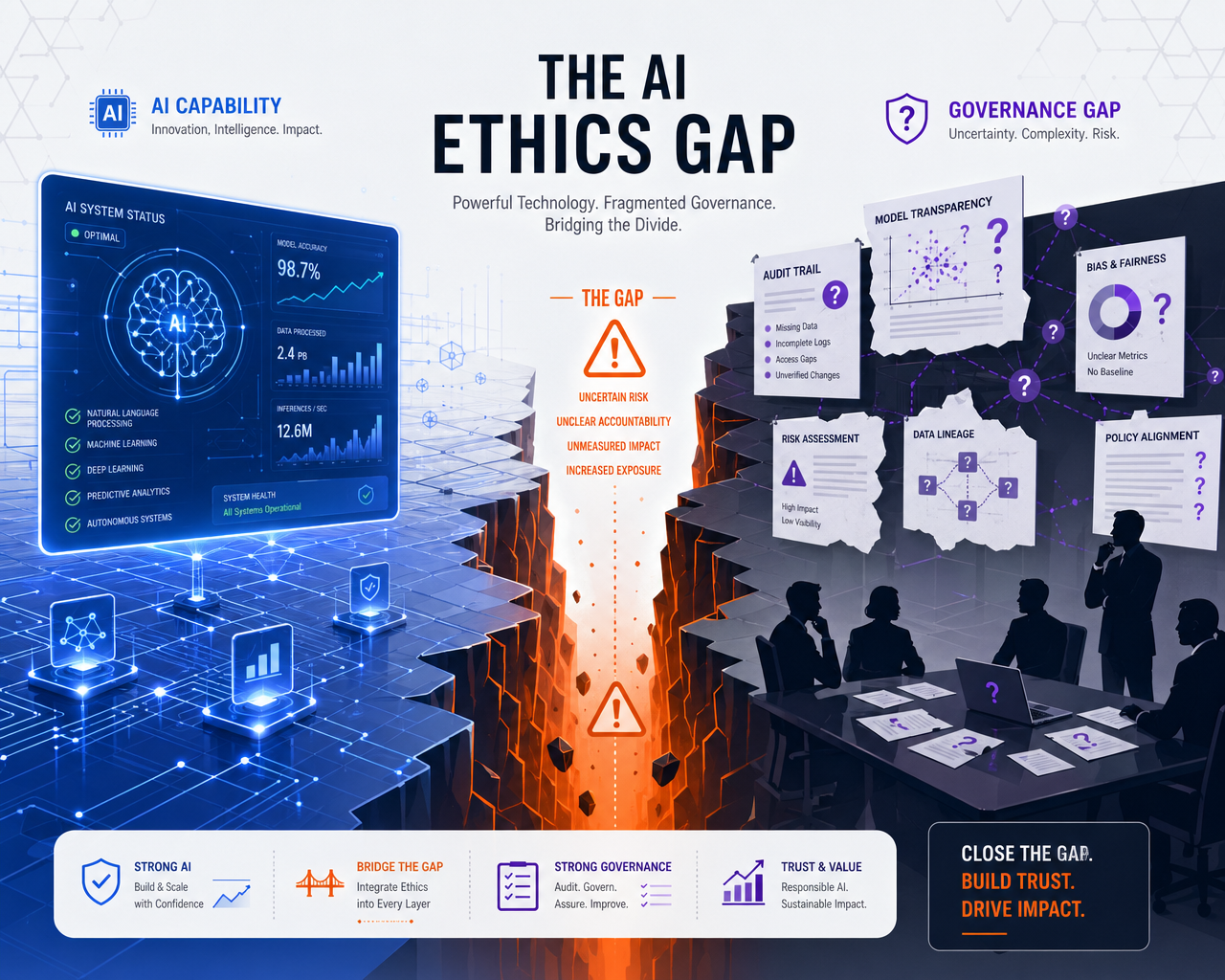
The AI Ethics Gap: Why Many Leaders Struggle With Governance Audits
The challenge is significant. Industry research suggests that a majority of business executives lack strong confidence that they could pass an independent AI governance audit within 90 days. This isn't just a compliance problem. It's a fundamental disconnect between how fast organizations are deploying AI and their ability to explain, control, and defend those systems.
The Proof Gap Between Pilots and Production
Organizations that are deploying AI often struggle to show how decisions are made and who is accountable for the outcome. This is the AI proof gap. Research indicates that organizations with fully integrated AI report significantly higher rates of revenue growth compared to those still piloting.
The difference isn't technical capability. The leading organizations can show how their AI makes decisions, who owns the outcomes, and what happens when something goes wrong. They've built governance as an operating system, not an afterthought.
The gap between piloting and fully integrated systems is substantial. Without strong governance, piloting and scaling produce activity — not outcomes. Every ungoverned initiative creates compounding risk. Each ungoverned initiative does not just create one gap. It creates a gap that makes the next initiative harder to govern, harder to measure, and harder to defend. The proof gap does not grow linearly. It compounds.
Why Current Approaches Fail in Real Business Decisions
When leaders are surveyed about organizational factors contributing to AI underperformance or failure, governance and compliance barriers are frequently identified as primary concerns, often ranking higher than insufficient training and data readiness issues.
The disconnect is striking. While many identify governance as a key problem, risk and compliance functions often receive less organizational focus in AI initiatives.
Most governance models weren't designed for the volume and speed of AI deployments. Centralized review bodies can get overwhelmed as use cases multiply, creating bottlenecks that slow the business without necessarily reducing risk.
Many organizations have drafted AI governance policies but struggle to turn them into daily practice, despite widespread awareness of emerging regulations.
The C-Suite Accountability Crisis
Inside many organizations, COOs overseeing AI-affected operations are discovering governance gaps that CFOs are not funding and that CIOs and CTOs are not surfacing. This misalignment creates dangerous blind spots.
While many boards have approved major AI investments, fewer have established clear governance expectations or made AI risk a regular oversight priority. Boards are often giving AI the green light, but many are not asking what happens if something goes wrong.
Research suggests leadership decisions strongly influence project outcomes: failed projects frequently lack clear executive alignment on success metrics, underinvest in data governance and foundations, treat AI as IT projects rather than business transformation, and lose active C-suite sponsorship within months. Projects with sustained CEO involvement tend to achieve significantly higher success rates than those that lose sponsorship.
The Regulatory Reality Check
Over the past year, regulators around the world moved from guidance to enforcement. What had been voluntary became mandatory. And for CIOs, the implications were immediate: AI governance is no longer judged by policy statements, but by operational evidence.
As new AI regulations take effect in the coming years, operational compliance will become both the norm and a regulatory requirement. With the EU AI Act implementation progressing and various state-level bills in the United States advancing—including frameworks in Colorado, California and New York—AI management will no longer be limited to declarations. Instead, AI management is becoming an infrastructural function embedded into how organizations operate.
Organizations without consistent, auditable oversight across AI systems may face higher costs, whether through fines, forced system withdrawals, reputational damage, or legal fees.
Building Governance That Works
The organizations closing the AI ethics gap aren't necessarily moving slower; many are moving faster because they have the confidence to scale. Leaders who have invested in governance often report being able to scale more quickly because they have established trust in their systems.
While governance implementation requires upfront investment, leaders need to be able to answer accountability questions consistently, and that requires an AI governance model with clear accountability, defined guardrails and documented evidence. A structured AI governance model that stands up to scrutiny starts with creating consistent accountability across the enterprise: Business and technology teams are accountable for how AI is used. Risk, legal, privacy and security teams define standards and oversee compliance. Internal audit independently evaluates whether controls are functioning as intended. This kind of structure replaces ad hoc oversight with durable ownership and clearer lines of responsibility.
When evidence capture is built into governance workflows, audit readiness becomes part of normal operations rather than a reactive exercise.
The reality is challenging but manageable. The question is no longer: Can the model perform? It is: Can the organisation control, audit, and take responsibility for its outcomes?
The Path Forward
The governance challenge isn't just a compliance consideration; it's a strategic factor. Organizations deploying AI without adequate governance may be building on unstable foundations. The companies that treat governance as an enabler, not a constraint, may be better positioned to turn AI investments into sustainable competitive advantage.
AI transformation may struggle not because models are weak, but because governance is insufficient. The defining capability of successful AI-driven organizations may become not just how fast they build, but how well they control, monitor, and take responsibility for what they build. In that sense, AI transformation is no longer only a question of technology maturity. It is increasingly a test of governance maturity.
The question every leader should consider: Can you demonstrate your AI works under scrutiny? If not, building governance into your AI from day one, making it an operating system that runs continuously alongside your technology, and creating accountability structures that turn capability into sustainable value may be essential steps forward.
Ready to strengthen your AI governance approach? Learn more about building responsible AI frameworks that are designed to address both regulatory requirements and business needs.

selfwritingprogram
Navigate AI's moral frontier — together.
Navigate AI's moral frontier — together.
Learn more about selfwritingprogram and get started today.
Visit selfwritingprogram