Beyond Compliance: How AI Ethics Platforms Actually Drive Business Growth
Many executives view AI governance as a cost center. That perspective may be limiting their growth potential.
While competitors worry about regulatory audits, some organizations are discovering something powerful: the potential business value that can come from AI governance to help unlock sustainable growth, with organizations that have integrated AI governance frameworks often showing improved audit performance and reporting stronger revenue trends.
The Growth Engine Hidden in Plain Sight
Industry analysts suggest significant growth potential in the AI governance space. The AI governance market is projected to experience substantial growth in the coming years, with expansion attributed to accelerating enterprise AI adoption across industries, emergence of structured regulatory frameworks governing AI deployment, and rising demand for transparency, fairness, and accountability in automated decision-making systems.
But here's what the surveys don't capture: these top-performing companies are using AI as a catalyst for growth and business reinvention, particularly by pursuing new revenue opportunities created as industries converge, while building strong foundations around data, governance and trust.
Adaptive Governance: The Framework That Scales
Traditional governance models weren't built for AI's speed. They can create bottlenecks that slow innovation. Adaptive governance aims to flip this dynamic, though implementation comes with its own challenges.
Minimum viable governance primarily focuses on implementing the essential, leanest set of governance policies needed for transparency and risk control without overburdening the organization and providing business value where ethical standards are met while remaining cost-efficient.
This typically means:
- Risk-tiered oversight: High-risk AI gets human review. Low-risk applications move fast.
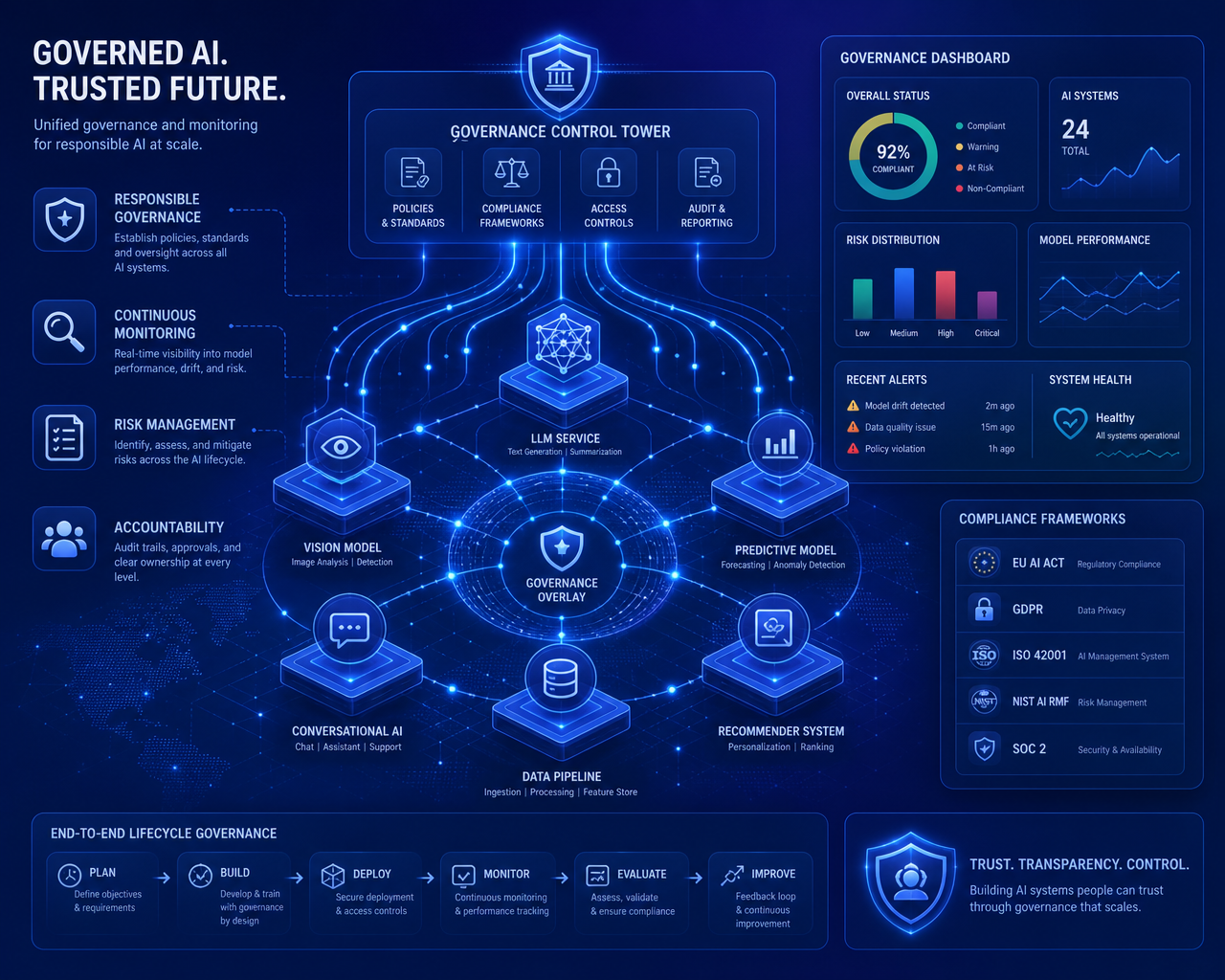
- Automated compliance monitoring: Systems check themselves against policy frameworks in real-time.
- Continuous learning loops: Governance policies adapt based on actual AI performance data.
The faster and deeper you can align IT, risk, and AI specialists with clear responsibilities and expectations, the easier it can be to operationalize an RAI framework that can help grow business value and stakeholder trust.
Automated Bias Detection: From Risk to Revenue
Bias detection isn't just about avoiding lawsuits. It may help identify missed opportunities.
When your AI systems are more systematically fair, they can make better predictions in many cases. Better predictions often mean better business outcomes. Ethical AI improves the quality and reliability of AI systems by addressing bias and ensuring fair outcomes, leading to better decision-making, improved innovation, and sustainable growth.
Practical implementation typically looks like this:
- Pre-deployment bias audits: Test models against protected classes before they touch real decisions
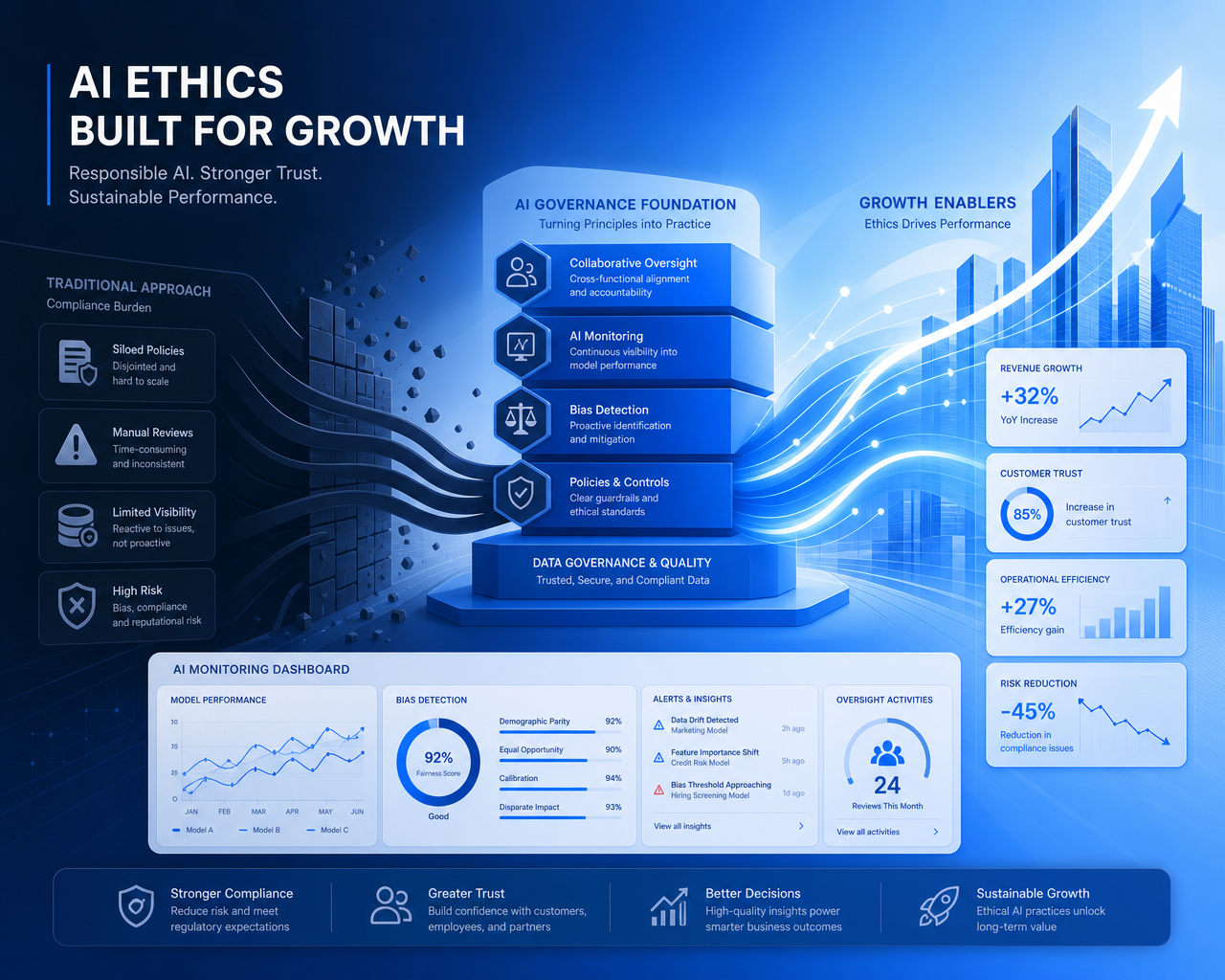
- Real-time monitoring dashboards: Track fairness metrics alongside business KPIs
- Automated alerts: Flag when models drift toward biased outcomes
- Correction protocols: Pre-approved steps to fix bias without stopping operations
Marketing teams, for example, are using AI for various tasks including summarization and translation, while risk and compliance teams often rely on it for anomaly detection, but the leaders are those who ensure these systems remain unbiased as they scale.
Cross-Organizational Collaboration Hubs
Silos can hinder AI initiatives. Organizations that foster cross-functional collaboration between IT, legal, compliance, and operational teams break down silos to ensure AI risk is managed holistically and that the organization responds quickly to new regulatory or ethical challenges.
Shared oversight hubs aim to solve this by creating:
- Unified dashboards: Everyone sees the same AI performance data
- Cross-functional review boards: Technical, legal, and business teams evaluate AI projects together
- Standardized approval workflows: Clear criteria for what AI can be deployed when
- Shared accountability: No one team owns AI risk alone
Collaborative teams use shared governance platforms where every decision and progress is documented and visible.
Implementation Roadmap: From Cost to Competitive Advantage
Note: Implementation timelines vary significantly based on organization size, existing infrastructure, and resources. The following represents a typical approach:
Phase 1: Foundation (Example: Months 1-3)
Create a comprehensive inventory of all AI models, their applications and their dependencies across the enterprise, as understanding where and how AI is used is the first step in managing its risk.
- Map existing AI systems and their business impact
- Establish baseline fairness metrics
- Set up basic monitoring infrastructure
Phase 2: Integration (Example: Months 4-6)
Start every checklist with a governance checklist, beginning from assessing data quality to checking privacy considerations, collaborate across teams using shared governance platforms where every decision and progress is documented and visible, and automate audit logging and anomaly detection alerts within AI systems.
- Deploy automated bias detection tools
- Create cross-functional review processes
- Build real-time governance dashboards
Phase 3: Optimization (Example: Months 7-12)
Implement automated tools and frameworks that enable real-time oversight of AI systems including testing and evaluation, compliance dashboards, compatibility protocols, observability frameworks, security monitoring and anomaly detection.
- Refine risk-tiering based on actual performance
- Expand automated monitoring to cover edge cases
- Transform governance data into business intelligence
Measuring Success: Beyond Compliance Metrics
The potential ROI of AI governance may show up in places traditional audits don't measure:
- Faster time-to-market: Pre-approved governance frameworks can eliminate deployment delays
- Higher model performance: Bias-free models may make more accurate predictions
- Reduced operational risk: Fewer AI incidents can mean lower crisis management costs
- Enhanced customer trust: Transparent AI may build stronger relationships
Companies that invest in ethical AI position themselves as leaders in trust, which is increasingly critical in today's digital economy.
The Competitive Reality
Looking ahead, governance may evolve from a constraint to become one of the most powerful competitive advantages a company can build. The organizations pulling ahead are not scaling more pilots — they are scaling fewer, with better measurement and clearer exit criteria, as depth creates the outcomes that justify the next investment.
However, implementing comprehensive AI governance requires significant investment in technology, personnel, and organizational change management. Success depends on executive commitment, adequate resources, and realistic timelines.
While your competitors debate whether to invest in governance, implementing these systems may offer opportunities to build infrastructure that turns ethical AI into a growth multiplier. By embedding responsibility, transparency and ethical oversight into the architecture of AI, organizations can unlock business value while strengthening public and stakeholder confidence, as in an economy increasingly shaped by intelligent systems, governance is more than a safeguard; it is a strategic advantage.
The question isn't whether AI ethics platforms always drive growth. The question is whether they can create competitive advantages for your specific situation.
Ready to explore transforming compliance overhead into competitive advantage? Learn more about building growth-focused AI governance at selfwritingprogram.com.

selfwritingprogram
Navigate AI's moral frontier — together.
Navigate AI's moral frontier — together.
Learn more about selfwritingprogram and get started today.
Visit selfwritingprogram